Toubkal Round Trek
- Duration
- 4 daysAvg. 6 h / day
- Distance
- ~48 kmAvg. 12 km / day
- Ascent
- +3700 mAvg. +925 m / day
- Descent
- -3700 mAvg. -925 m / day
Trip highlights
- Full loop of the western Toubkal Massif
- Tizi Aguelzim pass (3,560 m) and Toubkal summit
- Night in a Berber village guesthouse
The 4-day Toubkal Round trek takes you the long way to the top. Instead of the direct valley route, you loop around the western side of the massif — over the Tizi n'Mzik pass into the quiet Azzaden Valley, past the waterfalls of Azib Tamsoult and over the high Tizi Aguelzim pass at 3,560 meters before dropping into the Toubkal cirque.
The extra days mean better acclimatization, fewer crowds and a far richer picture of life in the High Atlas: terraced fields, shepherd huts and village homes where you’ll share mint tea with local families. You summit Toubkal on day three and return to Imlil by the classic valley trail.
Itinerary
Day by day, from trailhead to summit and back.
Day 1Imlil – Tizi n'Mzik – Tizi Oussem 05:30 h 12 km +800 m -700 m
Leave Marrakech for Imlil and start walking straight away. The trail zigzags up to the Tizi n'Mzik pass (2,489 m), with wide views back over the Imlil valley and ahead into the Azzaden Valley. Descend through juniper slopes to the village of Tizi Oussem, where you spend the night in a local guesthouse.
OvernightVillage guesthouse, Tizi OussemDay 2Tizi Oussem – Azib Tamsoult – Tizi Aguelzim – Refuge Toubkal 07:30 h 14 km +1600 m -250 m
Follow the Azzaden river up to the shepherd pastures of Azib Tamsoult and the Ighouliden waterfall. From there the real climb begins: a long series of switchbacks to the Tizi Aguelzim pass at 3,560 meters. On the other side, the trail drops into the Toubkal cirque and the refuge.
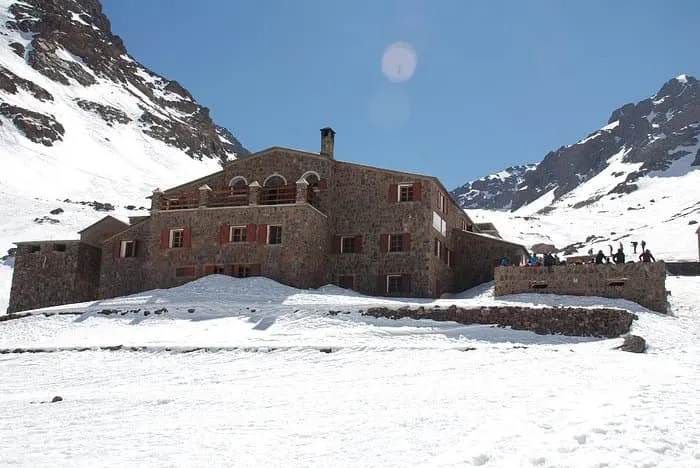 OvernightRefuge Toubkal Les Mouflons
Day 3Toubkal Summit and Back to the Refuge 05:00 h 8 km +940 m -940 m
An early start for the summit of Mount Toubkal (4,167 m). Well acclimatized after two days on the move, you climb the south cirque to reach the top for sunrise. Return to the refuge for a relaxed afternoon, a hot meal and a well-deserved rest.
OvernightRefuge Toubkal Les MouflonsDay 4Refuge Toubkal – Sidi Chamharouch – Imlil 04:00 h 12.4 km +10 m -1410 m
Descend the Mizane Valley past the shrine of Sidi Chamharouch and the village of Aroumd. Lunch in Imlil, then the transfer back to Marrakech.
What's included
Everything that's taken care of — and what to arrange yourself.
Included7
- Meals
This trek includes breakfast, lunch, and dinner.
- Transfers
All necessary transfers (bus, taxi, private transport, etc.) as described in the itinerary are included.
- Accommodation in guesthouses
Some nights are spent in simple local guesthouses (gîtes) run by mountain families, with shared rooms and bathrooms.
- Accommodation in refuges
During your trek, you stay in refuges. These are simple in nature but fully equipped. Do not expect too much luxury.
- Professional guide
During your trek, you will at all times be accompanied by an English speaking guide.
- Muleteer for luggage transport
A muleteer will be there to assist with transporting all the necessary equipment, luggage, food, etc.
- Water
Drinking water is available at the start of the trek and at every accommodation. If you want extra water carried by the mule, you’ll need to buy or fill it yourself and hand it over to the mule handler before setting off.
Not included7
- Traveling to and from
This trip does not include costs for transportation (flights, bus travel, etc.) to your destination.
- Personal expenses
Personal expenses such as souvenirs, drinks at the bar and other similar expenses are your own responsibility.
- Crampons and Ice Axe
In case you are summitting in winter, crampons and an ice axe are recommended. These are not provided by your trekking company.
- Sleeping bag
You must bring your own sleeping bag with you. You can rent a sleeping bag from your trekking company.
- Tipping
Gratuities for the guide are not covered by the trek's price. The amount to tip is at your discretion, yet if you've received excellent service from your guide, considering a generous tip is appreciated.
- Travel Insurance
Your international travel insurance is your own responsibility. It is important that your travel insurance also covers adventures at a high altitude. Discuss your itinerary with the insurance company before your trek.
- Accommodation before and after the trek
Before and after the trek you have to take care of your own accommodation in Marrakesh.
Frequently asked questions
When Is the Best Time to Climb Mount Toubkal?
The best seasons to climb Mount Toubkal are spring (March to May) and autumn (September to November). These bring mild temperatures and the weather conditions tend to be more stable, making the trek more enjoyable. Spring usually offers clear skies, while autumn provides cooler temperatures after the summer heat.
While Mount Toubkal can be climbed all year round, winter (December to February) brings snow to higher elevations, including the summit, making the ascent more challenging. Winter conditions require equipment like crampons and ice axes to complete the trek safely. In summer (June to August), lower areas can be very hot, but the higher elevations of Toubkal remain cooler, making it manageable for trekkers with more experience.
Is Climbing Mount Toubkal for Me? - Difficulty
Mount Toubkal is a non-technical but hard trek, largely due to the high altitude, with the summit reaching 4,167 meters (13,671 feet). While no technical skills are required, good physical fitness is essential, as you’ll cover up to 12 kilometers (7.5 miles) in a day with ascents reaching 1,400 meters (4,593 feet). Even seasoned trekkers can find the altitude demanding, so acclimatization is important. Also, keep in mind that for winter treks, additional equipment like crampons and ice axes are necessary due to snow and ice on the trails.
Despite its physical demands, this trek offers a true adventure, especially if you're used to trekking in the Alps or other familiar ranges. And don't forget you will be hiking with a skilled team of guides and muleteers, who will provide expertise and support, and will do their best to make the journey both manageable and enjoyable.
What Is and How to Prevent Altitude Mountain Sickness
When you climb above 3,000 meters, altitude sickness becomes a possibility. Since you’ll be sleeping at 3,200 meters on your first and possibly second night of the Toubkal trek, it’s important to recognize the symptoms so you can take action if needed. Altitude sickness symptoms can appear within a few hours at high altitude and may include nausea, shortness of breath, headaches, dizziness, fatigue, and difficulty sleeping. If left unchecked, it can take away from the experience and make physical exertion feel much harder.
Getting to Morocco and Marrakesh
Most trekking adventures in Morocco begin in Marrakech, a vibrant and well-connected city that acts as the main entry point to the Atlas Mountains. Traveling to Morocco is convenient, with numerous international flights arriving daily at Marrakech Menara Airport (RAK).
Marrakech is accessible via direct flights from various major European cities:
- Amsterdam (KLM, Transavia)
- Paris (Air France, Transavia, easyJet, Ryanair)
- London (British Airways, easyJet, Ryanair)
- Madrid (Iberia, Ryanair)
- Frankfurt and Munich (Lufthansa, Ryanair)
- Brussels (Brussels Airlines, TUI Fly)
If you're traveling from outside Europe, you can easily connect through cities like Madrid, Paris, or Casablanca before flying into Marrakech.
Transportation upon arrival is hassle-free. Our local team in Morocco will greet you at Marrakech Menara Airport and provide a direct transfer to your accommodation in the city. When your adventure concludes, we’ll ensure your return transfer to the airport is just as smooth.
All you need to do is step off the plane—we’ll handle the rest.
What if the dates I want are not available?
Most of our treks show availability on the date-picker when you select your preferred dates. We do our best to keep it as accurate as possible.
If your chosen date isn’t available, you’re always welcome to contact us — we’ll gladly check for alternatives or let you know if there have been any last-minute cancellations.
If I book now, can I immediately arrange the rest of my trip?
We recommend waiting until your trek is fully confirmed before booking flights, train tickets, or other travel arrangements.
Once you place your booking, our team will begin a manual confirmation process. This means we’ll contact the local partners and accommodations to secure your selected dates. Only after everything is confirmed on our end will we send you an official confirmation of your trek.
We completely understand the desire to plan your trip as soon as possible, but to avoid any changes or additional costs, it’s best to wait until your booking has been officially confirmed.
How do I know if this trek is right for me?
To choose the right trek, it’s important to consider your fitness level, previous trekking experience, and the specific needs of your group. Start by reviewing the trek details, especially the daily distances, elevation gain, and the trail difficulty rating. We use the following grading system:
- T1 (Easy): Well-marked paths, no exposure. Suitable for beginners and families.
- T2 (Moderate): Uneven trails, some elevation. Good fitness and sure-footedness needed.
- T3 (Demanding): Longer stages, rocky terrain, exposed sections. For experienced hikers.
- T4 (Difficult): Alpine terrain, steep and exposed. Only for well-trained, confident trekkers.
Are you new to trekking? Then go for T1 or T2 treks — they’re ideal for beginners and casual hikers. Have you done long-distance hikes before? Then T2 or T3 routes are likely more up your alley. Pick a trek that matches your fitness and comfort level. All logistics are arranged — you just need to choose the right route.
Still unsure? Our trekking experts are happy to help.
Can meals be adapted to my dietary requirements?
In many cases, yes. After booking, we’ll ask you to share any dietary requirements you may have. We’ll then pass this information on to our local partners and (where applicable) the accommodations.
Most treks can provide vegetarian options. Other dietary requirements, such as food allergies, lactose intolerance, or gluten intolerance, depend on the region and local availability. We’ll pass your requirements on, but we can’t guarantee they can be met throughout the trip.
Keep exploring Toubkal
More routes in the High Atlas, and the guides our team wrote to help you prepare.